
Adapalene and tretinoin both treat acne, but neither is the best choice for everyone. Comparative trials
suggest adapalene can deliver similar improvements with less irritation than certain tretinoin
formulations. Your acne severity, skin tolerance and the complete prescription matter more than
choosing the ingredient with the strongest reputation.
If you are comparing Differing with tretinoin, first check exactly what each tube contains. A single
retinoid and a retinoid combined with an antibiotic are different treatment decisions.
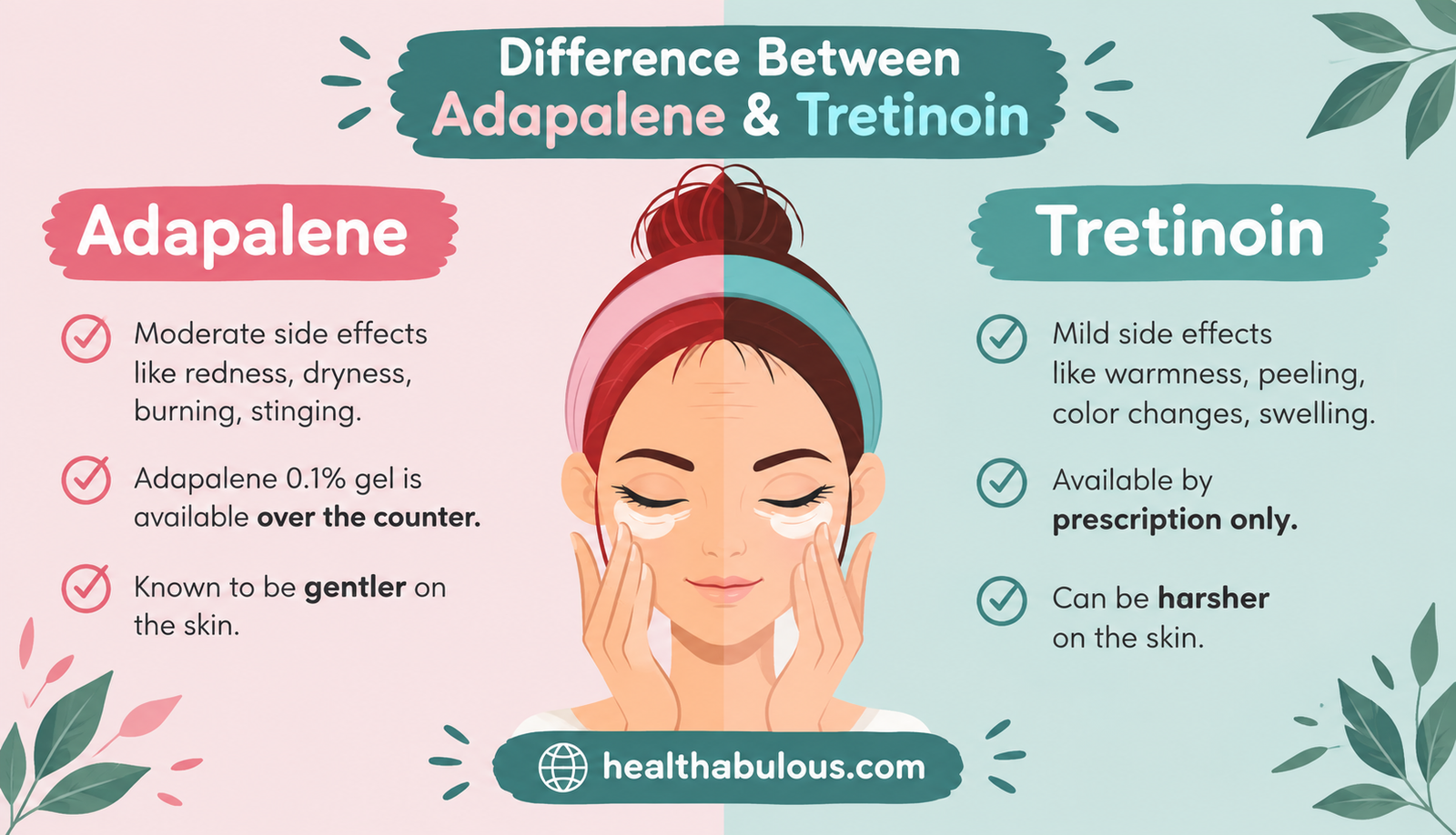
Adapalene vs Tretinoin at a Glance
| Question | Adapalene | Tretinoin |
|---|---|---|
| What is it? | A topical retinoid used for acne. | A topical retinoid used for acne. |
| UK example | Differin contains adapalene 0.1%. | Treclin contains tretinoin 0.025% plus clindamycin 1%. |
| Effectiveness | Helps blocked pores and inflamed spots. | Helps blocked pores and inflamed spots. |
| Tolerability | Often better tolerated in direct comparisons. | Irritation depends on strength and formulation. |
| Prescription needed? | Yes, for UK Differin. | Yes, for UK Treclin. |
| Pregnancy | Avoid during pregnancy and when planning pregnancy. | Avoid during pregnancy and when planning pregnancy. |
These examples are not a complete UK product list. The comparison draws on medicine information
and clinical trials; it does not establish that every adapalene preparation outperforms every tretinoin
preparation.

How Do These Retinoids Work?
Acne develops when hair follicles become blocked and inflammation contributes to spots. Retinoids
influence how skin cells develop and shed inside follicles, helping reduce existing blockages and
prevent new ones. They also have anti-inflammatory effects.
This explains why treatment usually covers an acne-affected area rather than only the largest visible
spot. The aim includes reducing tomorrow’s breakouts, not simply shrinking today’s blemish.
Neither ingredient is the same as oral isotretinoin, the capsule treatment used for selected cases of
severe acne. Their names sound similar, but their dosing, risks and monitoring are different. Never
substitute advice about one for instructions about another.
Cosmetic retinol is also different. A serum marketed for “renewal” should not be assumed to offer the
same acne treatment as a prescribed retinoid.
Which Works Better for Acne?
A randomised trial comparing adapalene 0.1% gel with tretinoin 0.05% cream in mild to moderate
acne reported equivalent efficacy and better tolerability with adapalene. Another trial comparing
adapalene 0.1% gel with tretinoin 0.1% microsphere gel also reported better tolerability with
adapalene, with comparable improvement in lesion counts.
These findings make adapalene a reasonable option to discuss when irritation is a major concern. They
do not mean tretinoin is ineffective, outdated or automatically unsuitable for sensitive skin.
There are limits to applying these studies. They examined particular strengths and formulations, not
every product currently sold. They also cannot predict whether your skin will respond exactly like the
average participant’s skin. A comparison involving a cream cannot settle every question about a
different gel.
Why “Stronger” Is Often Misleading
The percentages are not a shared potency scale. Adapalene 0.1% is not automatically four times
stronger than tretinoin 0.025%. They are different molecules, and the vehicle carrying the medicine
also matters.
A useful question is: “Which treatment can control my acne at a tolerable schedule?” If one product
repeatedly causes enough discomfort that you stop applying it, its theoretical advantages may have
little practical value.
Likewise, an improvement after switching does not prove the new ingredient is universally superior.
Application habits, other products, treatment duration and the natural course of acne may all have
changed.
What Is Available in the UK?
Differin 0.1% gel is a prescription-only adapalene medicine for mild to moderate acne. Adapalene also
appears in combination treatment with benzoyl peroxide, an option included in NICE guidance. A
combination should be assessed as a complete treatment, not as adapalene alone.
Treclin is a prescription-only gel containing tretinoin with clindamycin, an antibiotic. Its instructions
require careful evaluation before continuing beyond twelve weeks. It is not simply a tretinoin
moisturiser to keep renewing indefinitely.
A private service may offer another preparation, but ask for its full ingredients, licensing status,
instructions and review arrangements. Do not assume that an overseas product, a compounded
prescription and a licensed UK combination are interchangeable.
Availability and prescribing decisions can differ between services. Ask your GP or pharmacist what is
suitable locally rather than relying on a shopping link or another person’s prescription.
Who Might Discuss Each Option With a Clinician?
When Adapalene May Be Worth Discussing
Adapalene may be a useful discussion point if you have blocked pores and inflammatory spots,
especially if previous treatment caused troublesome irritation. Its comparative tolerability is a reason
to consider it, not a promise that it will be comfortable from the first application.
Tell the clinician whether you previously stopped because of burning, lack of improvement, cost or a
complicated routine. Those problems call for different solutions.
When Tretinoin May Be Considered
A tretinoin-containing prescription may be appropriate within a clinician’s acne plan, including when a
combination treatment is indicated. Your previous response and the other ingredients should guide
that decision.
If tretinoin already controls your acne without troublesome effects, a favourable study about
adapalene is not, by itself, a reason to switch. Ask what a change would improve for you specifically.
When Neither Is Enough Alone
Painful nodules, developing scars or substantial emotional distress need assessment. A more
comprehensive plan may be necessary. Repeatedly changing between two creams can delay care
when the main issue is acne severity.
How to Fit Treatment Into Your Routine
Start With Clear Instructions
Confirm the exact product, application area, amount and schedule before starting. NICE advises
considering alternate-day application or short-contact treatment initially to reduce irritation from
topical retinoids, then progressing if tolerated. Agree the approach with your prescriber because
product instructions differ.
For Differin gel, the usual instructions describe a thin layer on dry, affected skin at night. Avoid eyes,
lips and damaged, sunburnt or eczematous skin. Using extra will not produce faster results. [3]
Keep a photograph of the packaging and written instructions. This is particularly useful if the pharmacy
later supplies a different brand or formulation.
Keep Supporting Skincare Simple
Use gentle cleansing and avoid scrubbing, astringents or attempts to dry every trace of oil away.
Choose products labelled non-comedogenic and remove make-up before bed. A moisturiser can make
dryness easier to manage.
Ask your pharmacist how to space moisturiser and other skincare around your particular medicine.
There is no universal layering timetable that suits every prescription.
Avoid changing your cleanser, moisturiser and treatment simultaneously unless advised. Introducing
several changes makes it harder to identify what helps or what triggers a reaction.
Protect Your Skin From Sunlight
Use sunscreen alongside shade and clothing. NHS advice recommends at least SPF 30 with good UVA
protection. Apply adequately and reapply as directed, especially after swimming or sweating. Avoid
sunbeds.
Even if a product is described as chemically stable in light, that does not remove the need to follow its
sun-exposure precautions. Chemical stability and skin protection are different questions.
Can You Combine Them With Other Acne Products?
Do not use adapalene and tretinoin together unless a specialist specifically directs your treatment.
Differin’s information advises against concurrent use of other retinoids or medicines with a similar
action.
Benzoyl peroxide can be used in an adapalene treatment plan, including licensed combined
preparations. With tretinoin, compatibility and application timing depend on the formulation. Do not
assume a routine designed for adapalene also suits Treclin.
List exfoliating acids, retinol serums, spot gels and medicated cleansers at your appointment. An
ingredient hidden in a toner can matter as much as the prescription tube
If your medicine contains an antibiotic, ask when that component will be reviewed. Combining or
extending antibiotic treatments without advice can create avoidable problems, including antimicrobial
resistance.
How Long Should You Wait for Results?
Acne medicines need time. The NHS explains that improvement may take two to three months,
depending on treatment. A few days of use cannot fairly answer whether a retinoid suits your acne.
NICE generally recommends reviewing first-line treatment at twelve weeks, considering improvement
and side effects. Review sooner if symptoms worsen significantly or treatment is intolerable.
Compare photographs taken in similar lighting and note new inflamed spots, painful lumps and
comfort. Brown marks may remain after active acne improves, so judging treatment only by leftover
colour can obscure progress.
Bring your actual, accurately recorded application history to the review. “I used it three evenings each
week” gives more useful information than “I tried it for months.”
Irritation, Pregnancy and Other Safety Questions
Dryness, redness, peeling and stinging can occur with topical retinoids. Mild irritation may improve
with adjustments, but severe burning, blistering or swelling should not be dismissed as a necessary
“purge.” Stop and seek advice for a severe reaction. Breathing difficulty or throat swelling needs
emergency help.
Treclin has additional antibiotic-related precautions. Significant or prolonged diarrhoea or abdominal
cramps require stopping it and obtaining medical advice. Tell your prescriber about bowel disease and
previous antibiotic-associated colitis.
Neither adapalene nor tretinoin should be used during pregnancy or when planning pregnancy. The
MHRA advises avoidance as a precaution despite low systemic absorption from topical use. If
pregnancy occurs, stop treatment and contact your clinician; accidental exposure does not itself
establish that harm occurred.
Treclin also specifies effective contraception during treatment and for one month after stopping.
Discuss this before starting or planning conception, rather than assuming all topical medicines have
identical instructions.
Breastfeeding advice is product-specific. Differin permits use with precautions against infant contact,
including avoiding the chest; Treclin should not be used while breastfeeding. Confirm your exact
preparation rather than applying one rule to every retinoid.
At your appointment, ask what success should look like: fewer painful spots, fewer blocked pores, or
preventing repeated relapses. Ask what you should do if irritation prevents regular use and who to
contact between reviews. Write these answers beside your schedule. A clear fallback plan can make
treatment easier to follow when your skin changes.
Frequently Asked Questions
Is Differin the Same as Adapalene?
Differin is a brand containing adapalene. Check the formulation and strength rather than relying only
on the brand name. A product containing adapalene plus another medicine has different
considerations.
Can I Switch Straight From Tretinoin to Adapalene?
Ask your prescriber for a transition plan, particularly if your skin is already irritated or your current
medicine contains an antibiotic. Clarify which product to stop, when to start and when to review.
Is Tretinoin Better for Acne Scars?
Do not choose either medicine expecting established pitted scars to disappear. Controlling acne helps
prevent further damage, but scar assessment is a separate question from selecting treatment for
active spots.
Which One Should I Ask About First?
Ask about the option that fits your acne severity, previous treatment and tolerance. Bring your current
products and pregnancy plans to the discussion. The best comparison ends with a manageable
treatment plan and a clear review date.